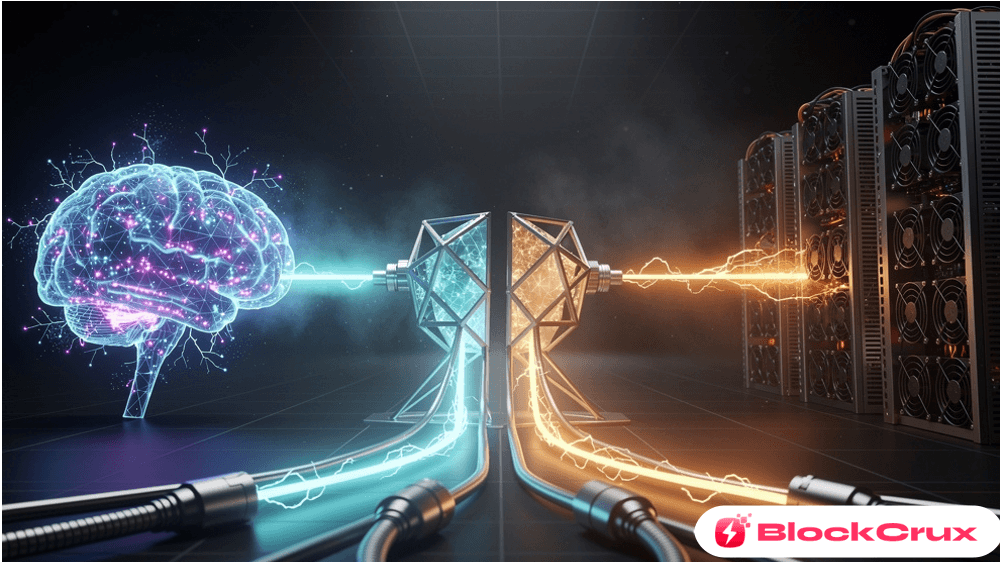
Bitcoin miners spent years lining up cheap power, substations and grid connections. AI companies now want that infrastructure, and some miners are trying to become data center landlords. The pitch looks simple: move the electricity to customers who pay more. The execution is not simple.
Power access is not the same as AI capacity
A mine can have energized megawatts and still need major work before it can host dense GPU racks. Cooling, networking, redundancy and construction financing all change the cost. CoinShares put conversion at roughly $8 million to $15 million per MW, versus $700,000 to $1 million per MW for ordinary mining infrastructure. That gap matters. A 100 MW grid connection also does not mean 100 MW of usable compute. At a power usage effectiveness of 1.25, about 80 MW reaches equipment and 20 MW supports the site.
SWI’s Genesis deal shows how hard it is to value this. SWI described more than 1.3 GW of energized and approved connections in June, then about 1.2 GW of secured grid connections later. The figures are not reconciled site by site. Its initial $500 million bought about 38.3% of Genesis equity and rights to preferred-share liquidation value, not a simple price per deliverable megawatt. Perhaps that structure makes sense, but it leaves outsiders guessing.
Contracts split the money
Core Scientific’s CoreWeave agreements are a clearer guide. CoreWeave funds or reimburses some construction and gets rent credits worth up to $1.5 million per MW. At a base fee of $100 per kW per month, a 1 MW site bills $100,000 monthly, but a 50% construction credit can cut that to $50,000. The customer helps pay for the build, then gets some of it back through lower payments. Core Scientific still borrows billions and faces late-delivery penalties, including daily credits of $20,000 and then $30,000 in specified cases. An uncapped completion guarantee adds more risk.
In the second quarter, Core Scientific reported $136.7 million of colocation revenue with 437 MW billing. Of that, $98.8 million was license fees and $35.1 million was power charges passed through. The electricity reimbursement also appears as an expense, so it lifts reported revenue without adding gross profit. More than a quarter of the revenue was essentially a utility bill.
The market is still early
A review of more than $100 billion in AI deals found only about 550 MW billing out of more than 4 GW under contract. HIVE’s $350 million AI agreement needed an estimated $185 million hardware buildout before most revenue could arrive. SWI is moving faster now, with a €800 million capital increase, roughly $1 billion in NVIDIA orders and first customers. But it has not said which Genesis sites will host that gear or how much of its 1.2 GW can be converted economically.
Miners do hold something scarce. I think the real test is whether they can turn that scarce connection into operating capacity without handing most of the economics to customers, contractors and lenders. The contracts, not the headline megawatts, will decide that.