Anonymous casino gambling gets described in two very different ways online. Affiliate sites often treat it as a loophole — a way to skip identity checks entirely. Regulators treat it as something narrower: verification that’s deferred, not removed. The second description is the accurate one, and understanding the gap between the two is the difference between picking a platform that operates legally and one that simply hasn’t been caught yet.
What Is an Anonymous Casino?
An anonymous casino is an online gambling platform that lets a player register, deposit, and start playing using minimal personal information — typically just an email address and a crypto wallet — instead of submitting government ID upfront. The term is often used interchangeably with “no KYC casino,” but the two describe slightly different things. No-KYC describes the verification policy; anonymous casino describes the player experience that policy produces. Neither term means the operator has no obligation to identify its customers at all. It means that obligation has been pushed further down the player journey.
| Anonymous Casino | No-KYC Casino | Traditional Licensed Casino | |
|---|---|---|---|
| What it describes | Player-facing experience | Underlying compliance policy | Standard verify-first model |
| ID required at signup | No | No | Yes |
| When verification happens | Deferred (usually at withdrawal) | Triggered by risk or threshold | Before first deposit or play |
| Payment method | Crypto wallet | Crypto wallet | Card / bank transfer |
This distinction matters because identity checks in gambling exist for a specific reason: preventing money laundering and fraud, not inconveniencing customers. Most licensing regimes require due diligence proportionate to risk rather than a blanket check at every step. Some jurisdictions require verification before any deposit or play occurs. Others allow it to be triggered once activity crosses a defined threshold. Anonymous casinos are built around the second model, not around having no obligations at all.
How Do Anonymous Casinos Stay Legal?
They stay legal by using a model regulators actually permit: risk-based KYC. Risk-based KYC is a compliance approach where identity verification is triggered by specific events — a large withdrawal, an unusual deposit pattern, a flagged transaction — rather than applied uniformly to every user at signup. This isn’t a workaround; it’s an accepted standard for handling lower-risk activity without demanding full documentation from every player on day one.
Curaçao’s licensing overhaul, which replaced the old master-licensee system with direct licenses issued by the Curaçao Gaming Authority, gave this model a clearer legal footing. Under the old structure, a small number of master license holders rented out sub-licenses to dozens of largely unsupervised operators. A direct license means one named company answers directly to the regulator instead.
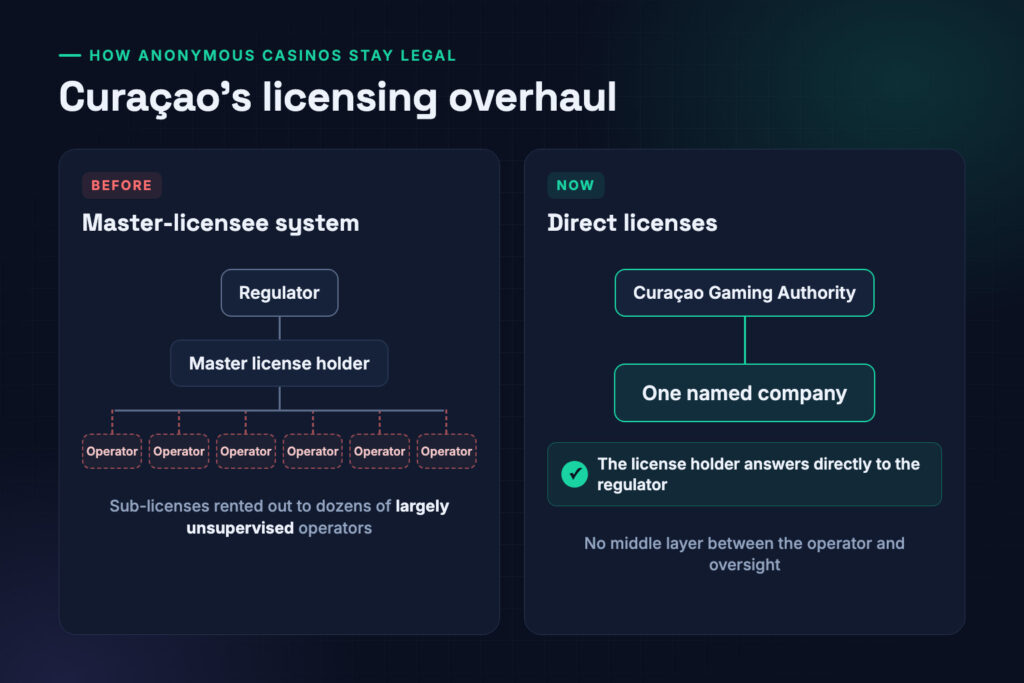
Jack.com operates inside that framework. It holds a direct Curaçao Gaming Authority license (OGL/2024/1562/1139, issued May 15, 2026) under Data Link Digital B.V., and uses this exact structure: a player can register with a username, email, and password and deposit within about 30 seconds, with no ID upload required to start. The obligation to verify hasn’t disappeared — it’s been moved to the point where it matters most, which is the cash-out.
What Actually Stays Private — and What Doesn’t
This is where marketing language and operational reality tend to diverge, and where players get caught off guard.
What typically stays private at signup: legal name, physical address, government ID number, source-of-funds documentation, and — because deposits and withdrawals move through a crypto wallet rather than a bank account or card — the direct link between a player’s real-world banking identity and their gambling activity.
What doesn’t disappear: the platform’s right, and often its obligation, to request identity documents once a player crosses a deposit or withdrawal threshold, or once a risk flag is raised internally. On Jack.com, that threshold sits at the withdrawal stage rather than at registration — proof of address or a source-of-funds document can still be requested before a payout clears, particularly on larger cashouts. The practical effect is a funnel that runs backward compared to a traditional licensed casino: friction at the front door is close to zero, and whatever verification exists is concentrated at the exit.
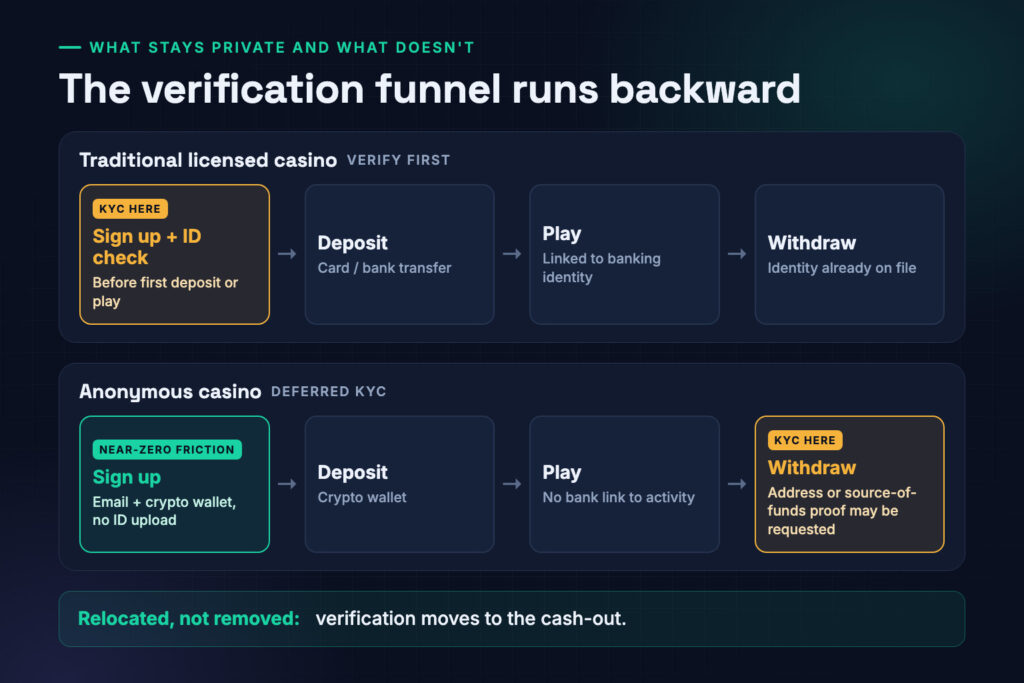
That’s a real trade-off, not a footnote. A no KYC crypto casino that defers checks to withdrawal isn’t eliminating oversight — it’s relocating it, and a well-run operator manages that relocation with rules communicated up front rather than surprise document requests after a win.
Jack Player Privacy in Practice
Jack player privacy, in concrete terms, means three things: crypto-only transactions instead of card or bank-linked deposits, no identity documents required to open an account or make a first deposit, and a wagering structure light enough that it doesn’t push players into the kind of extended, document-heavy play history that invites scrutiny prematurely. Jack.com’s welcome structure — a minimum $50 deposit unlocking spins with a single 1x wagering requirement on winnings, well below the 20x–40x common industry standard — is built around that same low-friction principle rather than requiring a long, trackable playthrough before a player can cash out.
None of this removes the withdrawal-stage check entirely. Player feedback about the platform follows a consistent pattern: fast processing on standard withdrawals, occasional delays on larger ones tied to a document request. What’s notable is what’s largely absent from that pattern — complaints tend to describe delay and paperwork on accounts that cross a risk threshold, not outright refusal to pay. That’s consistent with risk-based KYC functioning as designed, rather than an operator avoiding its obligations.
Anonymous Casino vs. No-KYC Casino: Where the Line Actually Sits
The two terms get used interchangeably, but they answer slightly different questions:
- Anonymous casino answers “how much of my identity does the platform need to see?” — the player-facing experience.
- No KYC crypto casino answers “when, structurally, does the platform collect that identity?” — the compliance mechanism underneath it.
A platform can be accurately described as both at once, which is the case with Jack.com: an anonymous casino from the player’s side of the screen, running on a no-KYC crypto casino compliance model that shifts verification to specific triggers rather than removing it.
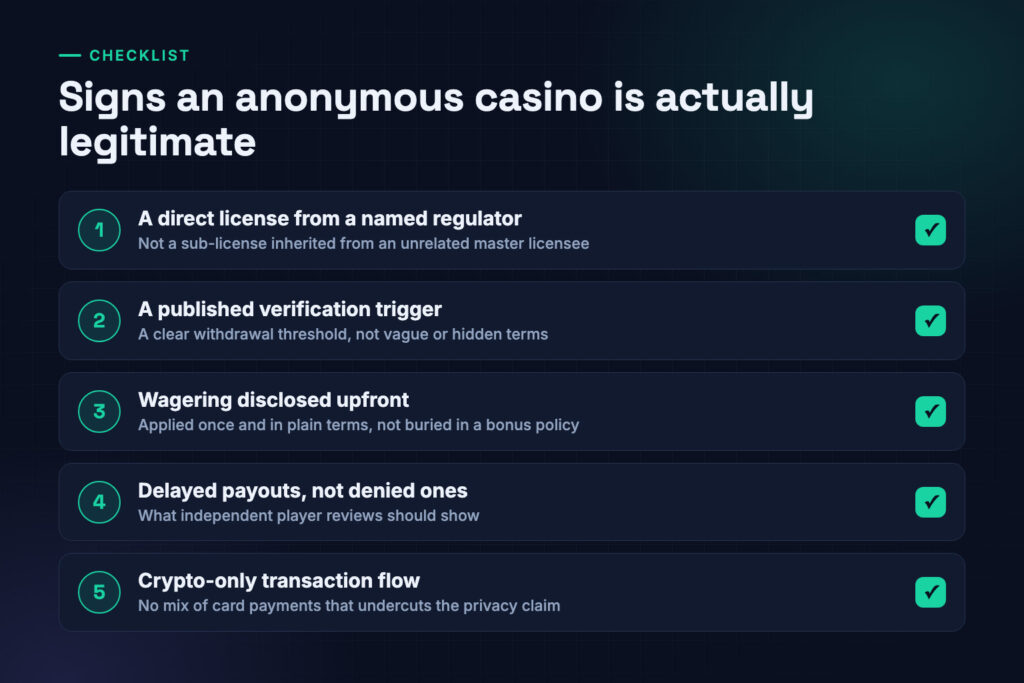
Checklist: Signs an Anonymous Casino Is Actually Legitimate
Before trusting any platform with the “anonymous” label, it’s worth checking for these markers:
- A direct license from a named regulator, not a sub-license inherited from an unrelated master licensee
- A clearly published withdrawal threshold or trigger point where verification kicks in, rather than vague or hidden terms
- A wagering requirement disclosed upfront, applied once and in plain terms — not buried in a bonus policy
- A track record of delayed payouts, not denied ones, when independent player reviews are checked
- Crypto-only transaction flow, rather than a mix of card payments that would undercut the privacy claim entirely
The Practical Takeaway
Anonymous casino gambling that stays inside the law isn’t about finding a site with zero verification — those either don’t hold a real license or aren’t enforcing the obligations attached to the one they have. It’s about finding an operator whose deferred-KYC policy is disclosed clearly, whose license is issued directly by a regulator rather than sub-licensed from one, and whose withdrawal-stage checks are a known, published condition rather than an unpleasant surprise. Judged against that standard, the model Jack.com runs — direct Curaçao licensing, email-and-wallet registration, and identity checks reserved for the withdrawal stage — is closer to how anonymous gambling is meant to work under current regulation than the no-ID-ever framing that still circulates in affiliate marketing.